What problems should I expect when buying a mid-century house?
A Portland house from the 1950s to the early 1970s comes with a few known questions: wiring, asbestos and lead, foundation bolting, oil tanks and the sewer line. How to check each one.
Jake Goodson · November 14, 2026
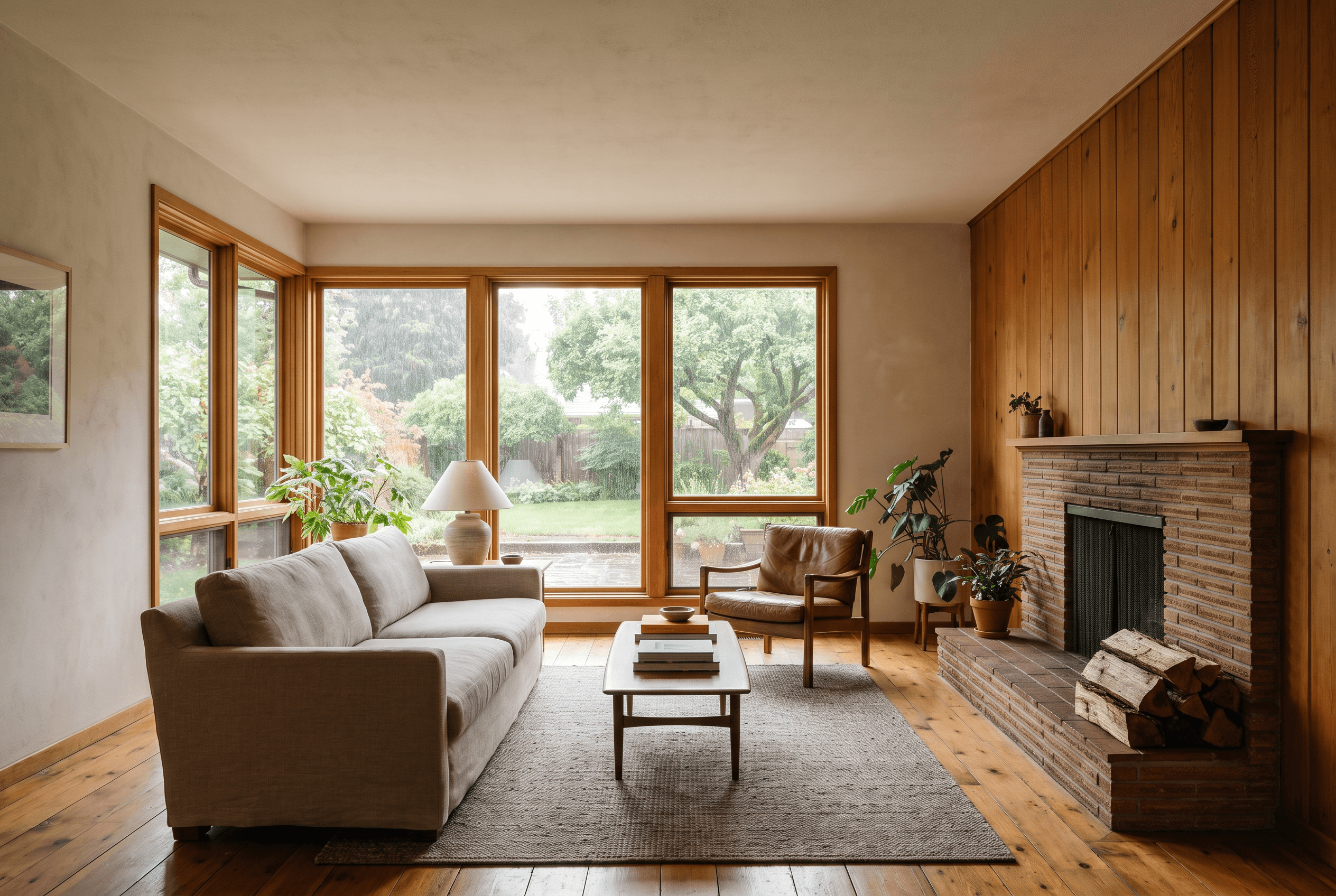
The short answer: a Portland house from the 1950s to the early 1970s usually comes with a handful of known questions, not a mystery. Check the wiring, the materials you'd disturb in a remodel, whether the house is bolted to its foundation, whether there's an old oil tank, and the sewer line. Most of these have a plain answer before you bid.
The trouble with mid-century houses is that you fall for them from the street. The low roof, the wall of glass, the post-and-beam ceiling that makes the living room feel twice its size. Then you're standing in it, and the part of your brain that's supposed to ask about the electrical panel is busy looking at the light.
That's fine. That's what these houses are for. Here's what to ask once you've finished looking at the light.
Is a mid-century house a different kind of old?
Yes. A 1920s Craftsman and a 1962 ranch are both older houses, but they ask different questions. We wrote about reading a 1920s Craftsman before you bid. A mid-century house is younger, so some of those worries fade, and a few others belong mostly to its own era.
Does it have aluminum wiring?
This is the one that's specific to the period. The U.S. Consumer Product Safety Commission says homes built before 1965 are unlikely to have aluminum branch wiring, and cable installed from 1965 to the mid 1970s may. So a 1958 house is probably fine on this one, and a 1968 house deserves a look.
You can check it yourself on a showing. The wire type is printed on the cable jacket every few feet, so look wherever the cable is exposed: an unfinished basement, the attic, the garage. If it's aluminum, the CPSC recommends a permanent repair by a qualified electrician. That's a known fix, and it's worth knowing about before you set a price, not after.
What about lead paint and asbestos?
Every mid-century house was built before 1978, so the federal lead disclosure rule covers it. Before you sign a contract, the seller has to tell you what they know about lead-based paint in the house and hand over any records and a federal pamphlet about lead. Read what they give you. "Nothing known" is an answer too, and it means nobody has tested.
Asbestos matters most if you're planning work. Oregon's Department of Environmental Quality says a house built before January 1, 2004 needs an asbestos survey by an accredited inspector before renovation or demolition. An owner working inside their own single-family home is exempt, but DEQ recommends a survey anyway, and lab testing is the only way to know what a material is. If you're buying with a plan to open up the kitchen, the survey comes before the sledgehammer. Put it in the timeline now.
Is it bolted to its foundation?
Oregon's seller disclosure form asks this directly. Under the heading "Seismic," it asks whether the house was built before 1974, and if so, whether it's been bolted to its foundation. Every house built in the 1950s and 1960s falls under that line.
Read the seller's answer. Yes, no and unknown are all on the form, and an unknown is worth a question. Your inspector can tell you what's there.
Is there an old oil tank?
Some older houses were heated with oil from a tank, sometimes one buried in the yard. If the owner doesn't know whether there's one, Oregon DEQ recommends that the buyer hire a qualified expert to check. A tank that's only been emptied hasn't been decommissioned. And if you buy knowing a tank is there and nobody has checked it for leaks, DEQ says you become responsible for any leaks found later. That's a sentence worth reading twice before closing.
What about the sewer line?
It's as old as the house unless someone replaced it, and you can't see it from the yard. We wrote about why a sewer scope is worth it on an older Portland house.
How do I know how efficient it is?
Look in the listing. Most homes advertised for sale in Portland need a Home Energy Score, on a scale of 1 to 10, based on the house's physical features rather than the last owner's bills. The report that comes with it lists ways to cut energy use, so it doubles as a list of projects. The city also says a low score "does not mean it is poorly built." It means there's room to improve, and on these houses, that's usually true.
So which problems should worry me?
Most of the list above has a known fix and a person who does it. The things that can't be fixed are the ones you'd lose: the original glass, the wood, the built-ins, the open plan. Once those are gone, they don't come back.
Our pick, if we had to choose between two 1960s houses, is the one where the wiring needs work and the paneling doesn't. You can call an electrician. Nobody can call 1962.
Original isn't the same as maintained, though. A worn original window is still worn, and an appraiser will treat it that way. We went through how appraisers handle these houses in Can a house with original mid-century features be appraised fairly? If you're the one selling, there's what to fix before listing a mid-century house.
Looking at a mid-century house?
Send it to us. We'll tell you what looks original, what's been changed, and what we'd check before you bid. Call us at 503.730.8677 or email hello@houselabteam.com.
The Houselab Team @ LikeKind Realty
Related
Is Alameda or Irvington better for buying an older home in Portland?
Two Northeast Portland neighborhoods full of houses from the 1910s and 1920s, side by side. Here's the difference that matters once you own one, and what we'd check on each before you bid.
Is buying a house near the Springwater Corridor a good idea in Portland?
It depends on the block. Here's what we check first, starting with the flood map, and how a house near the trail compares with the inner Southeast blocks you may have started with.