What should I know before buying a house in Laurelhurst?
Laurelhurst is a historic district of 1910s and 1920s houses. What the listing means for an owner, what's usually been changed, and what we'd check before you bid.
Tony Le · November 9, 2026
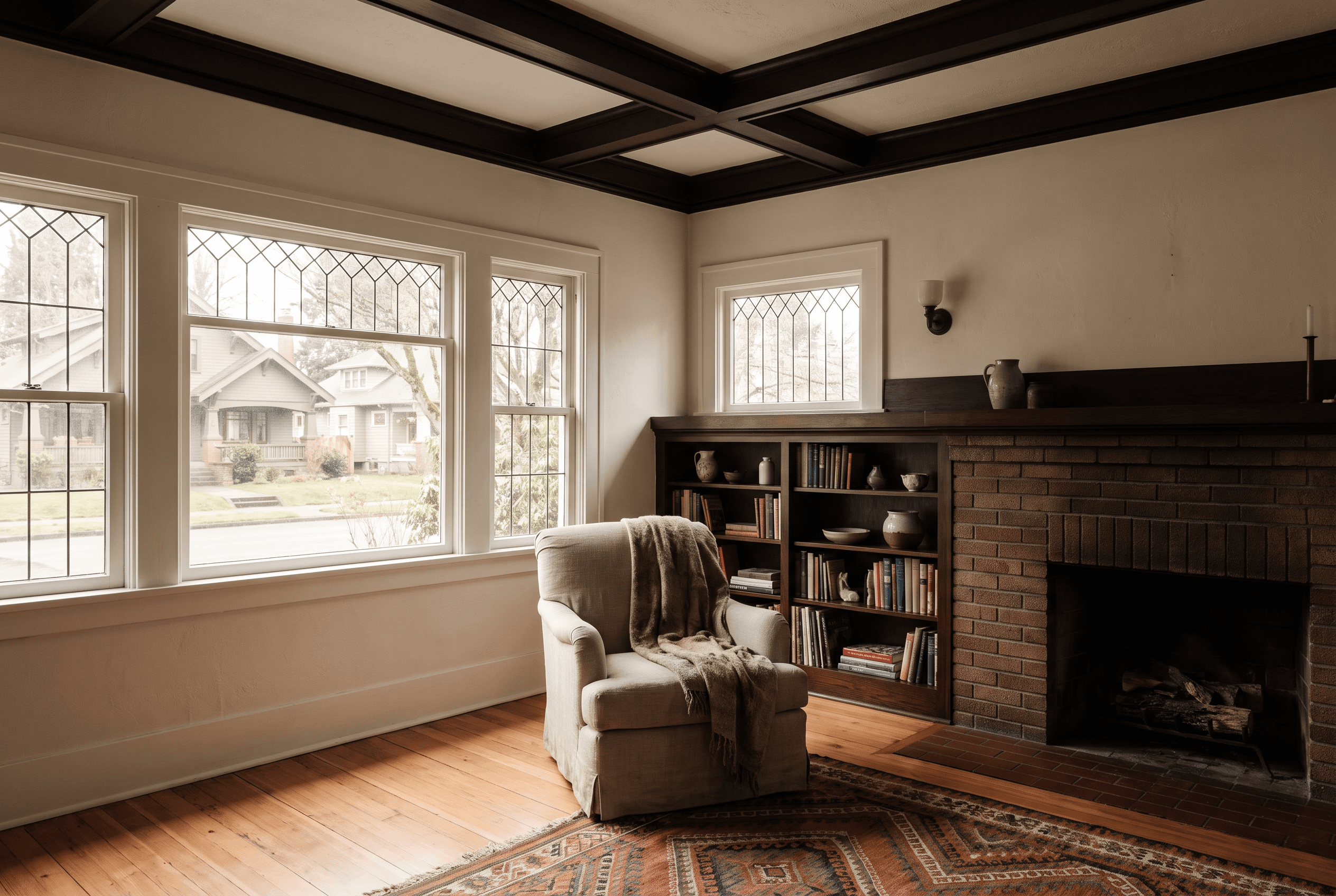
The short answer: Laurelhurst is a planned neighborhood of houses from the 1910s and 1920s, and the whole neighborhood is a historic district on the National Register. Before you bid on a house there, find out two things: whether the house is "contributing" to the district, and how much of it is still original.
On foot, Laurelhurst is easy to fall for. The streets curve when every street around them runs straight, the trees meet overhead, and the houses sit back behind real front yards. All of that was planned, and most of it is still there. Here's what the houses are, what the historic listing means for an owner, and what we'd look at before making an offer.
What are the houses like?
Old, mostly. According to the district's National Register nomination, 86 percent of the houses surveyed were built before 1930. The three styles you'll see most are Colonial Revival, Craftsman and English Cottage.
In plain words: the Craftsman Foursquare is the big boxy one, two stories or two and a half, with a porch across the front and four main rooms on each floor. The Craftsman bungalow is lower, with a broad, shallow roof and a wide front porch. The English Cottage came later, in the 1920s. It's the storybook one, narrow at the street and longer as it goes back on the lot.
The variety was on purpose. The company that sold the lots gave buyers a brochure of the styles it recommended: "Pure Italian, Japanese, Old English, Swiss Chalet, Colonial, New England, or Spanish Mission." Swiss Chalet made the list. We'd love to know who asked for it.
What does being a historic district mean for a buyer?
Here's the term you'll hear. A contributing house was built during the district's historic period and still has its original shape, materials and design, even if it's had small changes. A noncontributing house is inside the district but is newer, or has been changed past recognition. The nomination counts 1,751 properties in Laurelhurst, and 1,315 of them, about three in four, are contributing.
The City of Portland lists Laurelhurst as a National Register district, listed by the National Park Service but not designated by the city as one of its own historic or conservation districts. What applies to every contributing house is Demolition Review: the city requires it to tear one down.
For anything you'd change on the outside, like an addition, a new porch or different windows, ask the city about that project before you plan around it. Portland Permitting & Development offers a 15-minute appointment with a planner for exactly that kind of question.
What's usually been changed on these houses?
The nomination is specific about it. The most common changes are replaced windows, replaced siding, and additions or dormers on the back. Garages, which mostly sit in the back corner of the lot, have often been made bigger.
Windows are the easiest place to start. The originals are wood, with real divided panes. On a lot of houses, the front window on the main floor used to be one large pane with a row of small panes above it, and in the 1950s many of those were swapped for one big picture window. Vinyl windows show up around the neighborhood, and the nomination says they aren't original to any house built before 1949.
The siding tells you something too. The originals were painted wood boards or shingles, and cedar shingles were the most common kind. Fiber-cement boards made to look like wood came much later, so on a 1920s house they're a replacement.
None of this makes a house a bad buy. It tells you what you're paying for. Our pick is the house that still has its original front window, transom and all. It's the detail you notice from the sidewalk, and it's the one the 1950s took out on a lot of these houses.
What else should we check on a house this age?
The nomination says most of these houses sit on concrete foundations with full or half basements. Go down there on the first visit. A basement tells you more about a 100-year-old house than the kitchen does.
Then the sewer line, which is as old as the house unless someone replaced it. We wrote about why a sewer scope is worth it in Portland. For the woodwork and the bones, we wrote about how to read a 1920s Craftsman before you bid.
One more thing to know about the street. Lots are usually 50 feet wide, so houses sit about 15 or 20 feet apart. The neighbors are close, and the big street trees are part of the district too. Their leaves will be part of your fall.
What's it like living there?
The neighborhood straddles Burnside. Most of it is in Northeast Portland, with the southern quarter in Southeast. At the center is Coe Circle, a roundabout with a statue of Joan of Arc.
Laurelhurst Park is the other anchor. The city bought 30 acres of it, pond included, in 1911, and its park superintendent designed it in 1912. The pond was dug out into a three-acre lake, and the park has been on the National Register since 2001. If you're picturing morning walks around the water, that's the place.
Looking at a Laurelhurst house?
Send it to us. We'll tell you what style we think it is, what looks original and what doesn't, and what we'd check before you bid. Call us at 503.730.8677 or email hello@houselabteam.com.
The Houselab Team @ LikeKind Realty
Related
Is Alameda or Irvington better for buying an older home in Portland?
Two Northeast Portland neighborhoods full of houses from the 1910s and 1920s, side by side. Here's the difference that matters once you own one, and what we'd check on each before you bid.
Is buying a house near the Springwater Corridor a good idea in Portland?
It depends on the block. Here's what we check first, starting with the flood map, and how a house near the trail compares with the inner Southeast blocks you may have started with.